

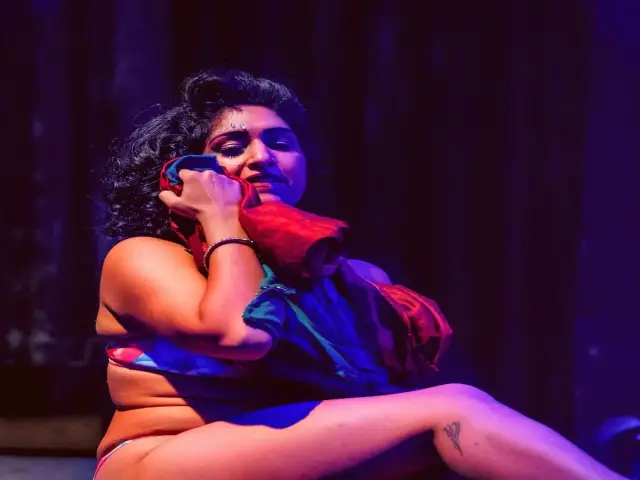

Kellita Maloof began her dance journey at a young age, yet it was only during her recovery from a severe flare-up of ulcerative colitis-a debilitating autoimmune condition impacting the digestive tract-that she truly recognized the profound gifts dance had bestowed upon her. Surprisingly, it wasn’t the classical ballet she had pursued as a teenager, but rather burlesque, which she encountered in her thirties, that unlocked this deeper understanding.
‘I first delved into burlesque practice 25 years ago, and it required a full decade before I even began to grasp the essence of what I was truly engaging in,’ explains Maloof, the visionary founder of the Hot Pink Feathers burlesque troupe in San Francisco, established back in 2000. She elaborates further:
In that period of rehabilitation, I experienced an intense phase of introspection, deeper than what most people ever access due to various life constraints, and that’s when it clicked-how I had been harnessing burlesque all along. Within a burlesque performance, I cultivate complete presence and association with the moment. Instead of adhering rigidly to preset choreography, I continuously check in, moment by moment, millisecond by millisecond: ‘Am I truly here? Am I fully embodying my physical form? Am I making deliberate, conscious choices right now, in this space with these individuals? Do I genuinely consent, deriving joy and delight from unveiling the next layer?’
Maloof’s transformative encounter is far from isolated. Countless personal narratives from women reveal how they have embraced burlesque as a pathway to enhanced self-perception, bolstered by an expanding collection of scientific investigations.
Tracing its roots to ancient Greek satirical theater, burlesque artfully merges dance, music, and parody to simultaneously honor and satirize sexuality. It employs exaggeration and ridicule to challenge societal norms, provoke thought, and expand cultural boundaries.
As articulated by Julia Persky, an assistant professor at East Texas A&M, ‘For centuries, burlesque has provided the working classes and the underprivileged-those on the societal margins-with a venue for entertainment and respite through captivating theatrical displays.’
Upon arriving in America during the 19th century, burlesque evolved to become closely linked with striptease and various exotic dance styles. Over the years, it has undergone multiple evolutions, periods of obscurity, and revivals, culminating in the mid-1990s with the rise of what is now known as neo-burlesque.
In this modern iteration, ‘the art form has wholeheartedly adopted and reimagined numerous historical elements, captivating enthusiastic audiences that are frequently queer and predominantly female,’ observes historian Betsy Golden Kellem. ‘Contemporary burlesque captivates through its embrace of diverse body types, its playful subversion of gender roles, its mockery of entrenched power dynamics, and its capacity to foster both amusement and personal metamorphosis.’ Notably, neo-burlesque is predominantly created, performed, and propelled by women and those presenting as femme for fellow women.
Extensive research underscores the therapeutic advantages of dance and movement therapies in processing trauma, yet burlesque distinguishes itself by centering on the female sexual and sexualized form. ‘It enables performers to not only intellectually comprehend this embodiment but to experientially feel it,’ notes Jacki Willson, an associate professor specializing in performance and gender studies at the University of Leeds in the UK, who has dedicated years to examining this dance style.
Burlesque creates a secure environment for trauma recovery because ‘it promotes and disseminates a redefined self-sovereignty, consent, self-compassion, and nurturing care,’ according to Willson. ‘It navigates the delicate boundary between misogyny and sexual autonomy, between exploitation and ownership. This is achieved through performance techniques, movements, accessories, and archetypal personas that empower both the artist and spectators to reframe how power has been stripped away, while offering an expanding repertoire of dramatic strategies to reclaim it.’
It’s essential to note that not all individuals are attracted to burlesque for healing purposes, nor do all instructors frame it as such a space. Some performers might still be in the early stages of awareness, much like Maloof once was, struggling to identify or express their trauma-be it the acute ‘boom-boom trauma’ from a singular incident like sexual assault, or the insidious ‘drip-drip trauma’ originating from childhood attachment wounds, leading to a lifelong sense of being perpetually overlooked.
This is precisely why Maloof has framed her teachings, offered since 2010, as conscious burlesque. ‘One can intentionally and purposefully engage with it as a return to one’s core self,’ she asserts. ‘In the studio, every participant is prompted repeatedly: ‘What does it feel like to inhabit your own being?’ I guide them constantly to tune into bodily sensations-whether witnessing others or being witnessed-training everyone in a tangible way to return home to themselves.’
Burlesque, in her view, provides an unparalleled opportunity to be utterly seen and validated, which alone possesses immense healing potential.
Dancing with yourself
This quality likely explains why burlesque serves as a sanctuary for many marginalized communities, encompassing gay and lesbian individuals, Black performers, those with larger bodies, and people with disabilities.
In her doctoral dissertation exploring both contemporary and historical Black burlesque artists, Ashley Dunn posits that the genre functions ‘as a platform for Black women to redefine themselves and resist the constraints imposed by society.’
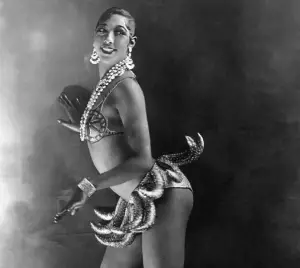 Burlesque trailblazer Josephine Baker emerged as an enduring icon of Black pride and resistance throughout the 1920s and 1930s.
Despite Black burlesque artists being systematically omitted from the genre’s official narrative, Dunn contends that numerous white performers appropriated their innovative moves: ‘Black artists have ingeniously repurposed, reclaimed, and reshaped burlesque-the very medium that once exploited them-into a healing ground for racial trauma.’
Given burlesque’s invitation to experiment freely with gender expression, it frequently honors queer identities, which face mounting societal pressures. Research indicates that neo-burlesque operates as a ‘queer emotional theater,’ where ’emotions and humor provide fleeting emancipation from daily afflictions,’ and ‘the physical manifestation of these emotions in neo-burlesque performances yields a queer catharsis-a brief respite from rigid norms and a whimsical reconfiguration of them, benefiting both performers and viewers.’
Laura C. Westmoreland, a therapist based in Los Angeles, first became captivated by burlesque after witnessing shows by Dita von Teese, widely regarded as burlesque royalty. ‘The sheer variety among the performers left me in awe,’ she recalls. ‘I saw reflections of myself in several of them.’
Following private instruction sessions, Westmoreland observed a profound shift in her self-perception. ‘I found myself locking eyes with my own reflection, forging an intense connection on physical, emotional levels-it was a revelatory ‘whoa, what just transpired?”
This epiphany inspired her doctoral research into recreational burlesque’s restorative effects. ‘Women navigate a world often requiring a mental detachment from the body for safety’s sake,’ she ponders. ‘Imagine a space for sensual movements where safety and reconnection prevail-what transformative impact might that have on our worldview and presence?’
These insights have reshaped her therapeutic practice, where she now guides clients to attune to their bodily signals and assess feelings of safety within. Westmoreland aims to integrate her findings into a program blending mental health strategies with burlesque routines.
Burlesque as community
Kaitlyn Regehr, associate professor of digital humanities at University College London, documented how mastering burlesque elevates self-esteem. Her analysis of eight women from the Canadian reality series ‘ReVamped,’ who cohabited with a burlesque choreographer for six weeks, revealed that all had endured painful romantic ruptures, including instances of abuse.
‘Every participant viewed the burlesque regimen as empowering and reported heightened self-efficacy,’ Regehr documents, inferring that ‘group burlesque practice may furnish a secure haven for personal discovery and emotional backing.’
Belonging to a community-where one is witnessed safely, offers and receives support, gains acceptance and affirmation, and feels included-profoundly aids those grappling with trauma and mental health struggles.
‘Burlesque welcomes, uplifts, and showcases all body types, extending beyond mere inclusion,’ emphasizes Jacki Willson. ‘Through striptease, it confronts the sexual and gendered harms inflicted on bodies and communities, yet this raw exposure, critique, and collective wound-bearing unfolds in a protective, respectful milieu that honors each person’s inherent value.’
Breaking stereotypes
London’s Invisible Cabaret, a burlesque and vaudeville ensemble, originated to dismantle stigma and shame surrounding mental health. Performers tackle subjects like depression, anxiety, eating disorders, obsessive thoughts, and the vital need for professional intervention.
‘Nudity on our stage from female bodies invariably underscores vulnerability, be it emotional or corporeal,’ states co-founder Rosalind Peters. ‘This demands meticulous curation to ensure performers feel-and truly are-utterly secure in their openness.’
Caroline Adkins notes that members of her Scotland-based Bump N Grind burlesque group ‘confront daily hurdles related to mental and physical health needs. Joining Bump N Grind has alleviated their anxiety, depression, and overall mental strain, fostering confidence, self-worth, body comfort, and realization of their vast capabilities.’
Susan Wolf witnessed these dynamics while producing her 2024 documentary, Learning to Be Naked: The Healing Power of Burlesque. It chronicles five women worldwide: an amputee and multiple-cancer survivor who dazzles with her prosthesis and scars; a 24-year-old stroke survivor post-childbirth who progressed from wheelchair to spotlight; and a plus-size, Black, nonbinary artist championing queer performers of color.
 Bolly Ditz Dolly of Invisible Cabaret. © Steve Gregson Photography
Burlesque not only offered these women a haven to mend from trauma and marginalization but also empowered them-and their audiences-to demolish conventional beauty ideals and question whose bodies merit visibility.
‘Burlesque shows differ vastly from formal dance productions-they’re interactive, with exuberant audience support,’ Wolf describes. ‘Viewers find validation in performers who have triumphed over grave adversities, achieving self-acceptance and love, which radiates empowerment and healing. It’s profoundly inspiring.’
During her research on fat burlesque classes, UCLA assistant professor Yessica Garcia Hernandez, specializing in Latina sexualities, popular culture, and performance, observed frequent body image discussions. One student’s tale of fat-shaming sparked dialogue on ‘how curviness is hierarchized, how even slender women endure fat phobia. These trauma echoes resound in the studio, alongside persistent diet talks.’
The sessions enabled Hernandez to address her own fat-shaming history, reframing her size not as failure but as resistance to a diet-obsessed culture prizing thinness.
‘In burlesque, where thin professionals dominate stages, fat women stripping onstage heralds ‘a brighter future,’ especially for plus-size aspirants deterred by size bias,’ she explains.
Body diversity
Burlesque aids women wrestling with aging-related anxiety and depression, countering the invisibility bred by youth-worshipping cultures. Middle-aged and senior women, often stereotyped as desexualized, benefit immensely from reclaiming sensuality, as detailed by Gemma Collard-Stokes, a performance artist and University of Derby research fellow. She examined nine women aged 50-84 in recreational burlesque.
Participants expressed disconnection from their self-image and bodies. ‘Reconnecting stems from rejecting inadequate body notions.’
Crucially, a validating community affirming their sensuality, femininity, and presence cultivated positive body esteem. Collard-Stokes summarizes:
The research illustrates how burlesque classes, stressing sensual body linkage, revive awareness of the body’s motion, expression, and strength potentials, cultivating contentment in one’s skin. Disconnection fades via gradual reconstruction of embodied living over body possession. As aging-support creatives proliferate, this underscores sensual dance’s role for women facing aging’s trials.
Maloof urges the curious to attend a performance or class to gauge evoked feelings. ‘Ample studies affirm movement and dance as healing,’ she affirms, adding:
I highlight proper witnessing-not merely physiques, but full personalities and worldly presences. We overlook our profound beauty, failing to sense or express it. Encountering true seeing unlocks self-vision. Biased as I am, I deem this paramount work.